
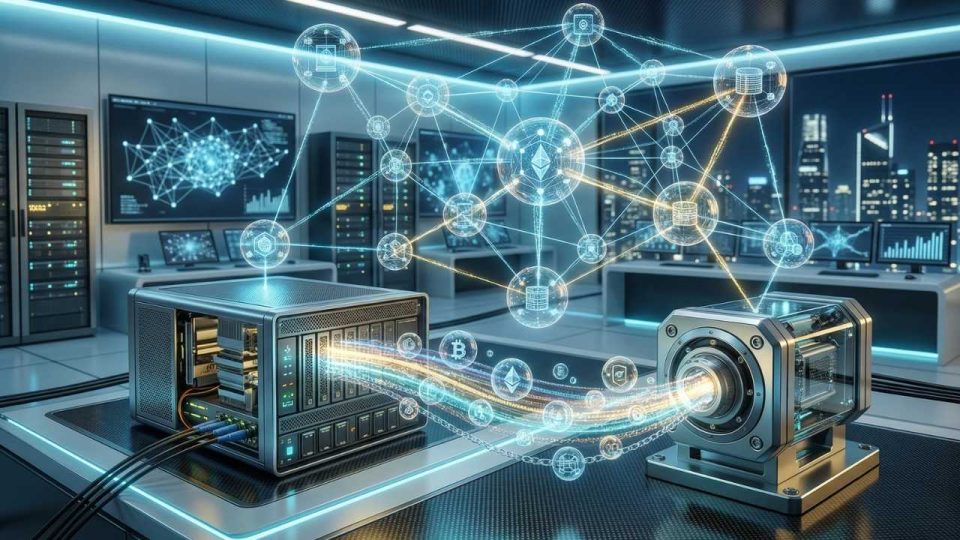
The massive adoption of machine-to-machine payments marks a definitive turning point in the contemporary digital economy. This technology allows autonomous devices to execute financial transactions independently, eliminating unnecessary intermediaries. The resulting operational efficiency completely redefines the traditional concept of current value exchange and digital interactions.
The traditional financial system, designed for slow human interactions, is unable to process the microtransaction volume required today. Blockchain technology emerges as the essential infrastructure for smart devices to manage their own financial resources. From this perspective, the financial autonomy of machines ceases to be science fiction and becomes fact.
The inefficiency of the Swift system versus digital autonomy
Current banking models fail to adapt to the speed of the automated economy and its technical demands. While an international transfer can take days, machine-to-machine payments require immediate settlement and negligible costs. The current scenario demands a real-time gross settlement system that is fully programmable and transparent.
Distributed ledger architecture allows an electric vehicle to pay for its charge without any human driver intervention. This process uses smart contracts to guarantee the automatic execution of predefined financial agreements between various connected devices. Decentralization offers the necessary cryptographic security to validate these interactions without human errors or delays.
This transformation is fundamental for blockchain to consolidate as the backbone of the global digital infrastructure. Without a network supporting thousands of operations per second, the Internet of Things would remain technically stagnant. The scalability of current networks allows processing financial flows with an accuracy previously unimaginable in markets.
The fundamental role of IoT in the machine economy
The exponential growth of connected devices requires a digital currency that is highly divisible and efficient. Machine-to-machine payments facilitate environmental sensors selling data directly to specialized research centers and corporate databases. According to the Cisco Annual Internet Report, there will be billions of globally connected devices very soon.
The ability to fractionate payments down to thousandths of a cent allows for totally disruptive business models. A key tool for SMEs will be the automation of their supply chains through these autonomous payments. The exchange of value between autonomous assets drastically reduces administrative expenses and operational waiting times for companies.
Far from being a coincidence, the evolution of microchips has facilitated the integration of digital wallets into hardware. Devices are no longer mere collectors of information, but economic agents with decision-making financial capacity. This transition toward the automatic payment economy is a central pillar of the industry 4.0 revolution.
Evolution since the 2017 and 2020 cycles
During the market boom in 2017, projects like IOTA first proposed a network without transaction fees. The IOTA Whitepaper described a protocol based on a directed acyclic graph to support lightweight devices. That technical vision laid the foundations for machine communication that we observe in the professional world today.
Later, in the 2020 cycle, the maturation of smart contracts in faster networks allowed for practical applications. The appearance of layer 2 solutions solved the previous congestion problems that limited frequent and small transactions. Simultaneously, the development of the Ethereum Virtual Machine standardized the way devices interact financially with each other.
In other words, the industry has moved from theoretical speculation to the implementation of tangible solutions. Past errors, such as high network fees, have been corrected with much more efficient architectures. The stability of current protocols allows machine-to-machine payments to operate constantly and securely across many different sectors.
Regulatory hurdles and the risk of centralization
While it is true that technology advances quickly, the international legal framework presents significant challenges today. Regulatory bodies, such as the U.S. SEC, closely monitor how automatic digital assets are issued and moved. The lack of legal clarity could slow down the massive adoption of these autonomous payment systems.
There is a risk that corporations will opt for private networks, limiting the benefits of real decentralization. A closed system would prevent the necessary interoperability between devices from different manufacturers and diverse geographical regions. The balance between data privacy and financial transparency remains a constant point of friction.
Nevertheless, market pressure for financial efficiency usually overcomes even the most complex bureaucratic barriers worldwide. Companies that do not adopt machine-to-machine payments will fall behind competitors with fully automated processes. Competitiveness in the digital age depends on the agility with which financial assets are moved.
The future of automated settlement and institutional flows
Major financial institutions are already exploring how to integrate these payments into their global asset settlement systems. The J.P. Morgan Onyx project demonstrates that the traditional banking sector recognizes the economic potential of machines. The institutional payment infrastructure is rapidly migrating toward systems based on high-speed distributed ledgers.
Various reports from the European Commission on IoT highlight the importance of standardizing digital communication and payment protocols. If institutional capital flows remain constant toward these technologies, we will see total integration in five years. The sustained investment flow validates the thesis that this is the definitive use of blockchain.
If the volume of transactions processed by autonomous devices exceeds 500 million daily, the system will be irreversible. Machine-to-machine payments will become the de facto standard for any logical and automated commercial interaction. The transformation of the global financial infrastructure is, therefore, a process that can no longer be reversed.
It would be a mistake to consider this technology as a minor addition to the existing financial system. We are facing the reconfiguration of global trade where humans are no longer at the center. The success of the machine economy will depend on the solidity and openness of the blockchain networks used.
