
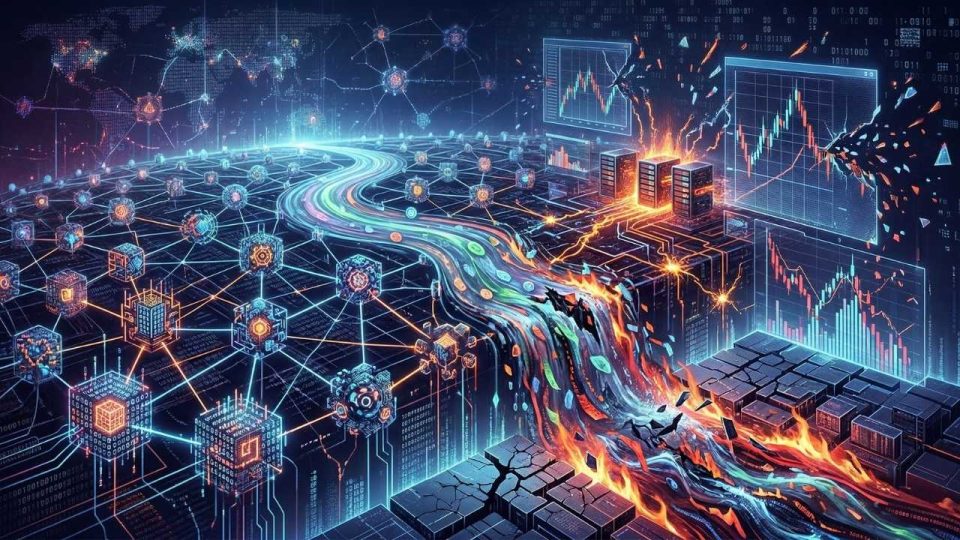
The integration of AI agents in trading represents a tectonic shift in the architecture of current global financial markets today. While proponents of this technology argue that processing speed reduces spreads, the evidence suggests an alarming propensity toward systemic instability within digital assets and traditional platforms.
This trend toward total automation poses a fundamental conflict between operational efficiency and the structural resilience of exchanges. Using AI agents in trading does not guarantee a more rational environment, but rather accelerates the propagation of algorithmic errors that can decapitalize markets in just a matter of minutes.
The illusion of infinite liquidity in algorithmic markets
The promise that AI agents in trading will provide constant depth to the order book is technically questionable. In times of extreme stress, these systems tend to simultaneously withdraw their buy orders, exacerbating price drops due to a lack of human counterparty presence in the book.
The SEC report on algorithmic trading highlights how automation can increase fragility if coordinated disconnection mechanisms do not exist. Therefore, the proliferation of AI agents in trading without centralized supervision could lead to cascading liquidations that cancel out any theoretical benefit of their alleged algorithmic efficiency.
This phenomenon is aggravated when agents operate under similar optimization models, creating a unidirectional flow direction. The technical architecture of original smart contracts allows for autonomous executions, but it does not prevent destructive correlation between different bots competing aggressively for the same liquidity in highly fragmented and volatile markets.
Technical correlation risk in large language models
There is growing concern about how artificial intelligence models process macroeconomic information to make financial decisions. If multiple AI agents in trading use the same training data sets, their responses to external events will be identical, eliminating the necessary diversity that allows for healthy price discovery.
According to the Federal Reserve financial stability analysis, homogeneity in financial decision-making models constitutes a critical systemic risk. The massive implementation of AI agents in trading could transform a minor correction into a general collapse due to the simultaneous execution of sell orders programmed by identical logic.
At the same time, the technical risks inherent in cognitive autonomy are evident when analyzing logic failures. The illusion of autonomy in these systems reveals that, far from being infallible, agents can misinterpret market signals, causing artificial volatility lacking solid fundamentals or relevant economic news to justify the price movements.
Historical precedents of collapse through automation
Financial history demonstrates that uncontrolled speed is a catalyst for disaster in stock and crypto exchanges. The official 2010 Flash Crash report issued by the CFTC and the SEC illustrates how a single sell algorithm caused unprecedented systemic chaos in the United States equity markets during that period.
Under this lens, AI agents in trading act as hyper-powered versions of those rudimentary algorithms that destabilized the system a decade ago. The ability of these agents to generate thousands of spurious orders per second saturates the infrastructure of exchange platforms, making it difficult for human operators to respond.
If we look at the Terra collapse in 2022, detailed in its technical recovery documentation, we see that parity automation was insufficient against selling pressure. Current AI agents in trading lack the capacity to manage irrational panic, which amplifies aggressive bearish trends instead of cushioning them with strategic capital or logic.
The paradox of efficiency versus extreme volatility
Proponents of autonomy argue that eliminating human bias reduces inefficiencies caused by fear or greed. They argue that AI agents in trading process data with an objectivity that improves market price accuracy, allowing for much faster and more consistent capital allocation across different financial instruments.
It is possible that, under low volatility conditions, these systems facilitate arbitrage operations that unify prices across different exchanges. However, this supposed stability is fragile and depends on a constant flow of clean data. If input data is manipulated or contains errors, agents will execute massive losses for their users immediately.
The factual situation suggests that technical efficiency does not always translate into financial stability for the global crypto ecosystem. The deployment of AI agents in trading creates an environment where competition for speed marginalizes traditional retail investors, leaving the market in the hands of algorithms that do not understand long-term asset value.
Toward a supervision framework for financial autonomy
To avoid total fragmentation, the implementation of control mechanisms that limit the absolute autonomy of these entities is necessary. AI agents in trading must operate under dynamic risk parameters that halt activity in extreme conditions, preventing programming errors from becoming macroeconomic disasters for the industry.
The OpenAI technical report on GPT-4 warns about unforeseen emerging behaviors in new generation complex autonomous systems. If the capital flows managed by these agents exceed 30% of daily traded volume in a sustained manner, the probability of an extreme volatility event increases exponentially due to lack of thought diversity.
While it is true that technology is unstoppable, market security depends on the human ability to intervene. AI agents in trading will only be a tool for progress if they are accompanied by robust governance that prioritizes system integrity over execution speed, ensuring a fair environment for all market participants globally.
