
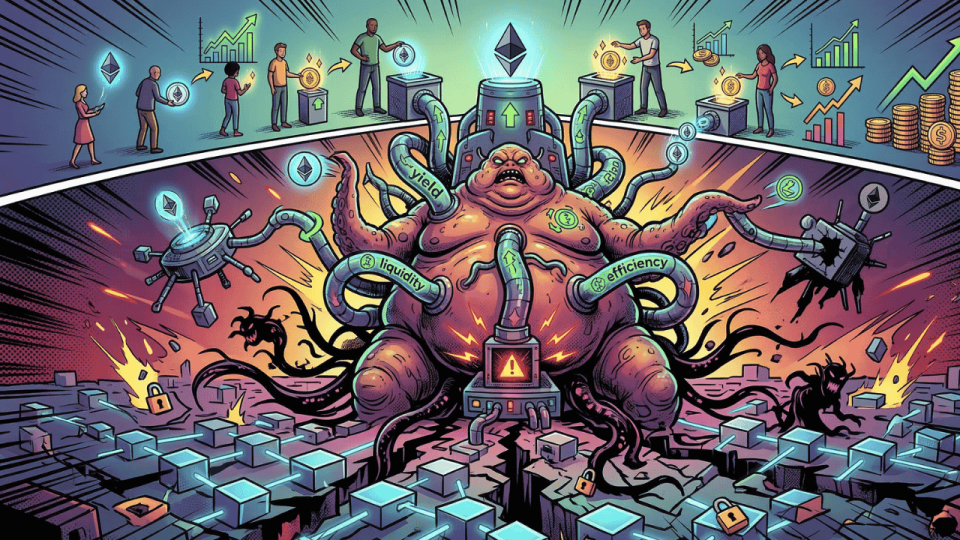
The prevailing narrative positions liquid staking as the ultimate evolution of decentralized finance. However, everything points to the fact that the relentless pursuit of yield is fracturing the very foundations of consensus. Far from being a panacea, we observe a ticking time bomb of liquidity.
The foundational thesis of the consensus mechanism, outlined in the official Ethereum documentation, required locking capital as a guarantee of honesty. Today, the derivation of those assets distorts the primary incentive, transforming the network’s shield into a high-impact structural vulnerability.
The Concentration of Deposited Capital
On-chain figures belie the discourse of financial democratization. According to recent DefiLlama metrics, this category amasses tens of billions, completely dominating the ecosystem. This hyper-concentration in just a few derivative providers represents an unprecedented centralization risk for consensus.
When a single liquid staking protocol approaches the critical thresholds of control over validators, the concept of decentralization evaporates. The underlying reality suggests we are creating an oligopoly where governance decisions fall upon a highly leveraged minority of corporate actors.
Put another way, the issuance of liquid derivatives like LSTs and LRTs dilutes the responsibility of the original validator. Capital flows towards yield farming while ignoring validation duties, which inevitably and progressively weakens the security of the native consensus.
The Regulatory and Systemic Spectrum
Institutional scrutiny over these structures is not a remote possibility, but an ongoing process. The SEC enforcement actions against centralized providers clearly demonstrate that federal authorities perceive the intermediation of staking rewards as an unregistered offering of investment securities.
Concurrently, global organizations are warning about these economic models. The Bank for International Settlements reports point out that hidden leverage in decentralized protocols amplifies macroeconomic shocks. The deep interconnection of these staking derivatives creates an imminent network of financial contagion.
While it is true that regulations seek to protect the retail investor, their clumsy application could fragment global liquidity. Platforms operating under this complex derivative model assume a massive legal risk that could easily freeze billions of dollars overnight.
Under this prism, the apparent efficiency of capital hides a gigantic opportunity cost. As we recently documented when analyzing why staking ETFs threaten capital efficiency, the intrusion of traditional managers alters organic dynamics, imposing a highly rigid institutional custody structure.
The intervention of government entities will not be limited to asset classification. The underlying reality suggests that central banks perceive the flight of capital toward these protocols as a direct threat to the transmission of traditional and centralized monetary policy.
When regulators demand Basel capital requirements from LST issuers, profitability will plummet. The inevitable bureaucratic friction will significantly increase the operational costs of nodes, further consolidating the market into the hands of a few corporations with immense financial muscle.
The Lessons of the Recent Past
The history of the crypto market is plagued by mechanisms that collapsed under their own weight. If we evaluate the 2022 bull cycle and collapse, the over-collateralization of supposedly safe assets triggered a massive solvency crisis. Constant rehypothecation generates a hidden fragility within the financial system.
Back then, artificial liquidity vanished when users attempted to redeem their positions simultaneously. Today, liquid staking protocols promise immediate exits, but in extreme panic scenarios, the main network’s withdrawal queue will act as a bottleneck, de facto blocking immediate liquidity.
Far from being a coincidence, periods of greatest financial innovation usually precede the most violent deleveraging events. The creation of secondary and tertiary yield layers on top of base staking is a direct echo of traditional derivative market historical crises.
To understand the magnitude of this evolution, one only needs to observe how Ethereum liquid staking experiences exponential growth reaching historic milestones. This institutional adoption validates the technology, but simultaneously introduces classic attack vectors from the traditional sector, merging two diametrically opposed financial worlds.
The Counterweight of Idle Liquidity
Those who staunchly defend liquid staking argue, with some reason, that locking billions of dollars in the base layer is a macroeconomic waste. For them, the issuance of derivatives allows securing the network while fostering a continuous creation of economic value.
From this perspective, derivative liquidity is the fuel that keeps innovation alive in the ecosystem. If users could not employ their capital in yield farming or as collateral, participation in consensus would drop, causing a drastic decline in network security.
The technical documents of the main providers, such as theLido foundational whitepaper, outline democratization mechanisms where any user can obtain yields without owning the technical infrastructure. This undeniable accessibility has allowed the entry of a record volume of retail capital.
This optimistic thesis would only be invalidated if the smart contracts underpinning the issuance of derivatives suffered an unrecoverable vulnerability. As long as the code holds and parity is maintained in secondary markets, the system functions as a highly efficient liquidity engine.
The Verdict on Capital Structure
Consequently, the debate does not lie in the utility of the tool, but in the limits of its expansion. The hyper-financialization of consensus transforms cryptographic security into a speculative financial product, deviating the network from its original and immutable decentralized purpose.
If institutional flows into liquid staking persist and the concentration of deposits exceeds fifty percent in a single protocol for more than three months, we will be facing the definitive capture of the base layer and an unprecedented governance systemic crisis.
Ultimately, the maturity of the ecosystem will demand a forced balance between yield and solvency. If the industry fails to establish self-imposed limits on rehypothecation, markets will face a systemic correction event that will completely redefine the rules of decentralized finance.
