Liquity vs MakerDAO: Is Absolute Immutability the Only Viable Path Forward Today?
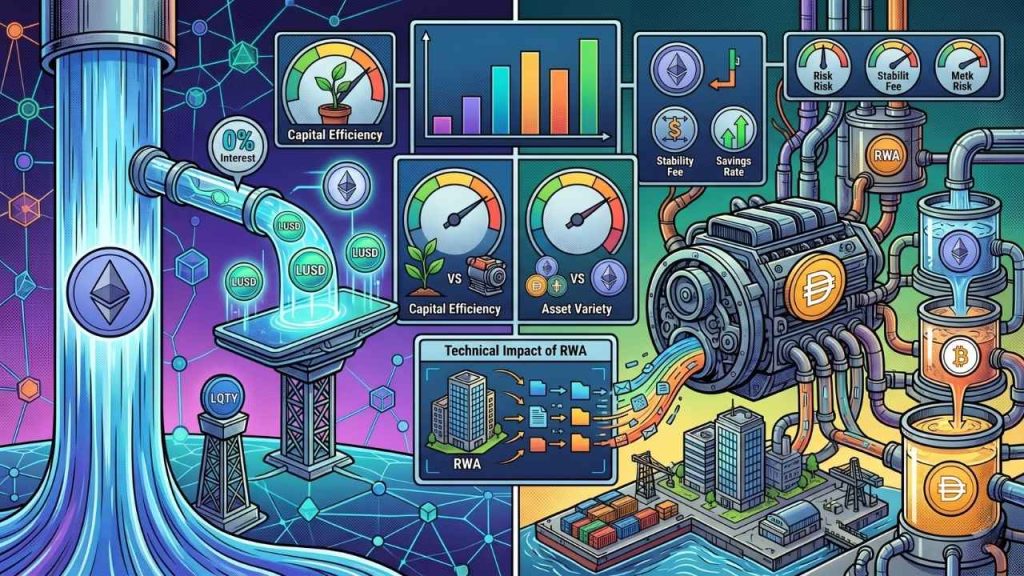
The decentralized finance market currently debates the optimal architecture for maintaining asset parity. Two opposing stability models define this technical and financial struggle. The reliance on traditional assets versus immutable algorithmic code clearly marks the institutional direction.
MakerDAO historically dominated the sector through active governance and collateral expansion. However, Liquity challenges this standard by operating without human intervention since its initial deployment. This architectural divergence is critical given the growing regulatory scrutiny over algorithmic stablecoins.
MakerDAO’s structure has evolved into a corporately managed risk model. The protocol actively integrates United States Treasury bills, explicitly documenting this process within its smart contract modules. This decision sacrifices censorship resistance in exchange for greater supply scalability.
This exposure to traditional finance generates intense debates regarding the protocol’s sovereignty. The dependence on centralized entities creates the DAI dilemma, questioning whether the asset can be considered truly resistant to government interventions or unforeseen corporate blockades.
Liquity adopts a radically different stance regarding the management of collateralized assets. The system maintains static parameters exhaustively described across its technical specification documents. Ether functions as the sole backing asset permitted for the continuous minting of currency.
Immutability guarantees that no committee can alter the collateral ratio or censor specific users. The architecture eliminates risk vectors associated with human behavior or the inherent voter apathy prevalent in decentralized autonomous governance systems across the industry.
Liquity requires a minimum collateralization ratio of exactly 110 percent. MakerDAO demands margins exceeding 130 percent for vaults based on volatile crypto assets. This stark difference evidences the capital efficiency achieved through an instantaneous and automated liquidation mechanism.
The immutable protocol executes liquidations by distributing the bad debt among stability pool providers. MakerDAO relies on temporal auctions where external participants bid for the collateral. The first method significantly reduces vulnerability during extreme blockchain network congestion.
Integrating corporate assets presents tangible benefits during severe bearish market cycles. The Bank for International Settlements details how backing with sovereign debt reduces price volatility in natively digital financial ecosystems facing massive cascading liquidations and panic selling.
Capital Efficiency Versus Censorship Resistance
MakerDAO manages to absorb greater liquidity by accepting centralized stablecoins as immediate collateral. This elasticity allows the system to maintain token parity through direct arbitrage. Financial scalability demands operational sacrifices that compromise the original decentralized vision entirely.
The LUSD model faces structural growth barriers due to its conservative mathematical design. The exclusive reliance on Ether restricts total issuance to the capital willing to assume exposure to a single asset. Organic growth becomes significantly slower.
A contrary view argues that active governance is indispensable for long-term operational survival. Financial markets frequently experience unpredictable events widely known as black swans. A rigid protocol lacks extraordinary emergency tools to respond to profound systemic crises.
This perspective gains validity when analyzing historical liquidity crises within the sector. MakerDAO modified its stability fees during market collapses to incentivize rapid debt repayment. A dynamic adjustment prevents insolvencies when secondary markets fail abruptly without warning.
The hypothesis regarding the superiority of the immutable model would be invalidated if Liquity suffers an unresolvable technical failure. The inability to update smart contracts means a critical mathematical error would result in total permanent loss of deposited funds.
Computer security plays a determining role in the fundamental viability of these economic models. Lacking updatable components and governance functions, Liquity massively reduces the available attack surface for malicious actors attempting to exploit complex network vulnerabilities maliciously.
MakerDAO interacts with multiple external oracles and cross-chain bridges to verify the existence of its physical assets. Every new integration adds layers of technical complexity. The dependence on third-party verifiers introduces operational vulnerabilities outside the protocol’s direct control.
Monetary policy also marks a profound operational differential between both financial platforms. While DAI requires constant adjustments to reflect traditional capital costs, LUSD floats freely, driven solely by supply and demand forces across diverse decentralized trading markets.
The Macroeconomic Impact on Decentralized Finance
The current ecosystem heavily favors institutional adoption over the initial strict cryptographic purism. Corporations demand steady yields backed by fully auditable physical assets. MakerDAO captures this corporate demand by distributing dividends derived from United States Treasury bond yields.
Liquity consistently attracts users who prioritize individual financial sovereignty and extreme predictability. Charging a one-time issuance fee effectively replaces variable interest rates. This mechanism allows investors to project long-term debt positions without worrying about unforeseen carrying costs.
Historically, complex financial architectures invariably tend to concentrate strategic decision-making power. MakerDAO voting data displays low participation rates among regular token holders. Large venture capital firms dominate strategic resolutions, effectively diluting the premise of egalitarian community management.
Traditional monetary systems have repeatedly demonstrated that centralized custodians frequently freeze assets under intense political pressure. If government agencies sanction real-world collaterals, a critical portion of the hybrid ecosystem’s monetary backing would become completely inaccessible and mathematically insolvent.
The global market will ultimately decide if practical utility justifies the assumed centralization risks. Asset diversification effectively reduces internal volatility but imports severe jurisdictional risks. The choice between both systems will depend on each institutional user’s specific risk profile.
If international regulations impose strict blockades on centralized stablecoin issuers during the next economic cycle, single-asset algorithmic protocols will absorb most of the exiled liquidity, proving that censorship resistance commands a vastly superior long-term monetary security premium.
Capital allocation decisions carry inherent fundamental risks associated with continuous and unpredictable decentralized market volatility. This article is strictly for informational purposes only and does not constitute formal financial advice.