T3 Financial Crime Unit freezes 450 million dollars in illicit crypto assets
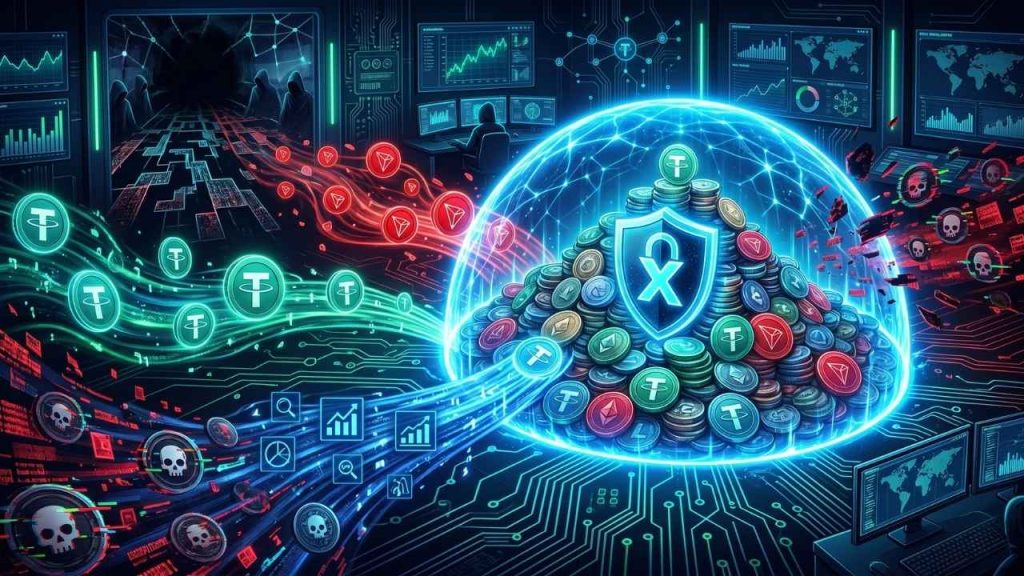
The T3 Financial Crime Unit, a joint initiative comprising stablecoin issuer Tether, the Tron blockchain network, and analytics firm TRM Labs, announced on May 14, 2026, the freezing of more than $450 million linked to suspected criminal activity. This volume of immobilized funds encompasses the unit’s operational period since its official launch in 2024. The freezes were executed through coordination with law enforcement agencies across 23 different jurisdictions to halt the flow of capital derived from illicit operations.
The operational focus of this unit centers specifically on the transactional activity of the USDT stablecoin hosted on the Tron blockchain. According to the release issued by the group members, established rapid response protocols allowed the organization to intercept funds within a 24-hour window across multiple emergency cases. This operational efficiency resulted in a substantial year-over-year increase, registering 43.9% more illicit proceeds intercepted during 2025 compared to the 2024 cycle.
Joint operations and jurisdictional scope Inter-institutional collaboration was structured to cover a criminal spectrum that includes drug trafficking, terrorist financing, and physical extortion. These violent crimes, cataloged in the industry as wrench attacks, involve kidnappings and direct threats to force the transfer of tokens. Seizure metrics reflect the unit’s capacity to track and neutralize the mobilization of these criminal assets across five continents through advanced on-chain forensic analysis tools.
The volume of interventions by the T3 Financial Crime Unit responds to the sustained growth of illicit financial flows globally. Estimates provided by TRM Labs within the same report indicate that the total movement of crime-linked cryptocurrencies reached a record $158 billion in 2025. This scenario has heightened the pressure on decentralized networks and issuing companies to establish stricter control mechanisms and cooperate actively with government agencies.
High-liquidity layer-1 infrastructures, such as Tron, are frequent targets of advanced cybercriminal organizations. Recent operational data demonstrates that the speed at which North Koreas crypto thieves operate has required more complex security deployments to prevent the laundering of funds stolen from centralized exchanges and DeFi protocols. The velocity of these token movements demands that compliance units operate with real-time monitoring systems.
Network architecture and contract control Despite the executed freezes, vulnerabilities in end-user custody continue to generate massive capital outflows. Industry technical reports attribute a significant portion of the losses documented in Web3 environments to poor private security key management and direct theft, factors that hinder the preventive work of forensic units and limit their actions to post-incident recovery.
The Financial Action Task Force (FATF) previously cited the T3 Financial Crime Unit in its reporting on public-private partnership models, designating it as a high-value resource for law enforcement. This institutional recognition contrasts with criticisms from sectors of the crypto asset market, which argue that the unilateral capacity to freeze balances increases centralization risks and alters the permissionless transfer model inherent to blockchain networks.
In response to inquiries regarding network control, Tron representatives specified that the platform functions strictly as an agnostic, low-cost technology provider. The base protocol architecture does not allow for monitoring individual users or blocking native transactions. The authority to identify illicit addresses and execute fund freezes rests exclusively with smart contract controllers, such as Tether, in coordination with TRM Labs’ investigations.
The actual impact of on-chain immobilizations transcends the numbers reported by the joint unit. Independent data from security firm BlockSec revealed that, in a 30-day period prior to May 2026, more than $500 million in USDT was frozen across various blockchains. This figure suggests a broader blacklisting activity by the issuing company. An official response from Tether remains pending regarding what percentage of the globally immobilized total corresponds specifically to tokens based on the Tron network.
This article is for informational purposes and does not constitute financial advice.