
Bumo Sarang records 32.7 million dollar loss on leveraged Ether ETFs
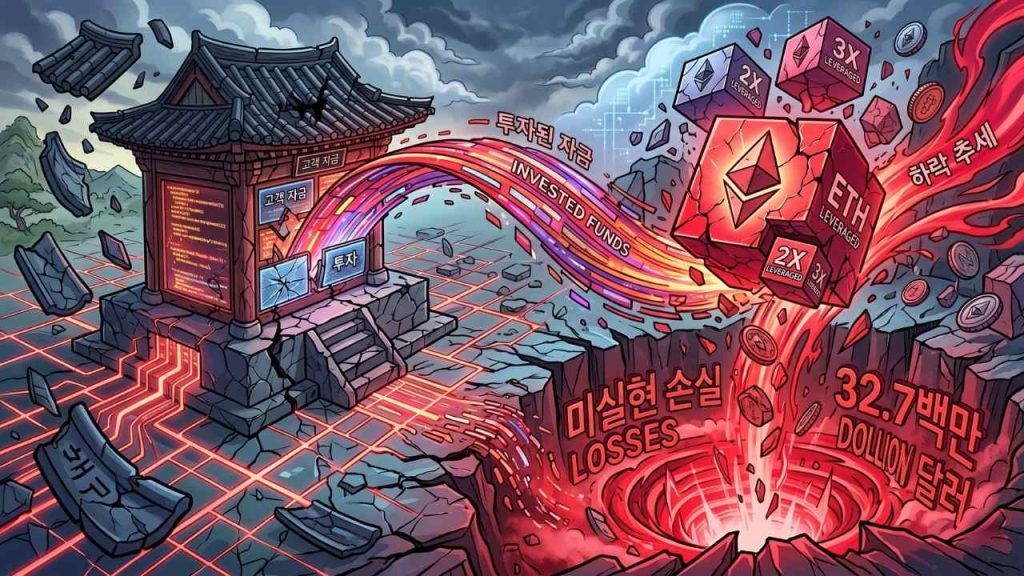
South Korean funeral and mutual aid service provider Bumo Sarang is currently holding an unrealized loss of 49.3 billion won, a figure equivalent to approximately 32.7 million US dollars. The financial mismatch originated after allocating roughly 59.5 billion won ($40 million) from its customers’ prepaid service funds into leveraged cryptocurrency exchange-traded funds (ETFs), according to the company’s official 2025 audit report.
Official records detail that these resources were specifically deployed into the T-REX 2X Long BMNR Daily Target ETF. This structured financial instrument doubles the daily performance of Bitmine, an enterprise treasury firm heavily focused on Ether ($ETH$). Concurrently, another industry peer named Christian Funeral Family of Faith registered a net loss of 500 million won ($331,700) during the past fiscal year, according to financial data disclosed by the Korea Economic Daily.
The exposure of user savings to high-risk financial assets has reignited the national debate regarding the oversight of funeral mutual aid entities in South Korea. Unlike traditional banking or investment institutions, these companies are not supervised by financial market regulators but fall instead under the administrative jurisdiction of the Fair Trade Commission (FTC). This specific regulatory framework enables them to manage large capital pools derived from customer advances without the standard corporate liquidity constraints imposed on banking institutions.
Aggregated domestic market data reveals that 43% of local funeral service providers hold total assets that fall short of the advance payments collected from their customer base. This liquidity deficit raises structural concerns regarding the companies’ capability to meet cash refund obligations in the event of sudden mass contract cancellations. Responding to public scrutiny, a Bumo Sarang representative stated that the firm is merely navigating a short-term accounting fluctuation caused by global market volatility, maintaining that the corporate balance sheet retains a sufficient financial buffer to absorb the loss.
Capital rotation and governance challenges in the crypto space
The flow of South Korean retail and institutional capital toward products linked to the Ethereum ecosystem experienced a rapid expansion during the preceding months. Quantitative market assessments calculated that approximately 6 billion dollars in domestic retail capital rotated out of traditional tech equities and into corporations carrying Ether-heavy corporate treasuries.
According to a technical review shared by industry executive Samson Mow on his official X account, a significant portion of these investment inflows was executed without a thorough understanding of the structural risks built into leveraged and index-linked derivatives.
The only thing keeping ETH at these levels is the Korean retail investor, specifically the seohak gaemie (서학개미). There’s around $6 billion dollars (dollars, not KRW) of Korean retail capital propping up the Ethereum treasury companies.
ETH influencers have been flying to… https://t.co/ezc2cGtQhx
— Samson Mow (@Excellion) October 5, 2025
This environment of elevated corporate exposure develops alongside ongoing internal restructuring debates regarding the operational trajectory of decentralized networks. Market participants frequently evaluate who really runs Ethereum as governance conflicts persist, introducing additional layers of price volatility for institutions that back their operational balances with this blockchain network.
Throughout 2026, the spot price of Ether has recorded a year-to-date decline exceeding 28%, trading hovering around the $2,118 mark. Concurrently, Bitmine’s equity price experienced a 40% retracement within the same timeframe, trading down to $18.7 per share. Despite the downward momentum, Bitmine’s executive board characterized the asset’s drop below the $2,200 threshold as an attractive accumulation opportunity after executing an additional purchase of 71,672 Ether units for its corporate holdings.
This article is for informational purposes only and does not constitute financial advice.