
Polymarket loses 660000 dollars in infrastructure exploit from compromised private key
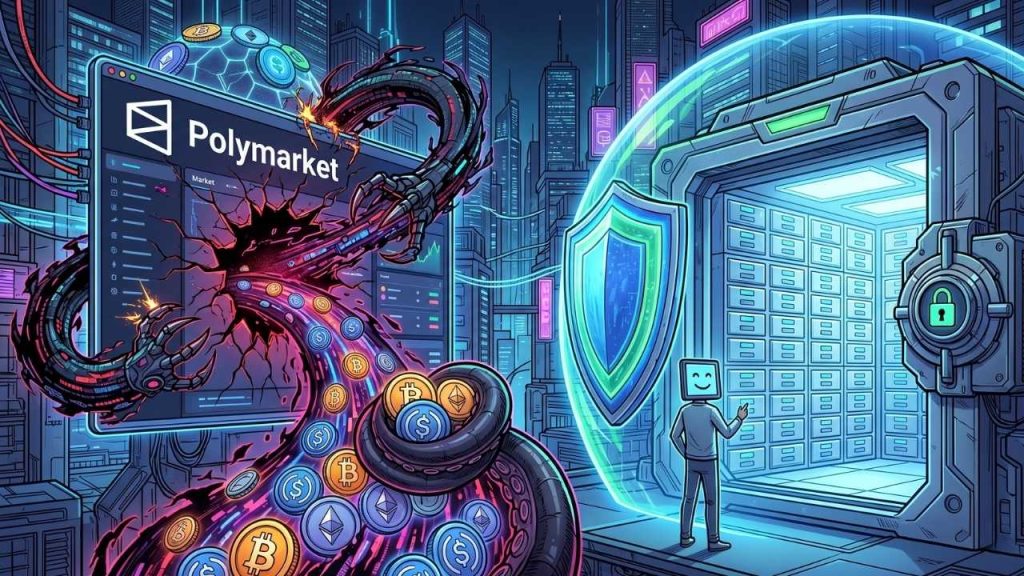
The decentralized prediction platform Polymarket suffered an infrastructure exploit of 660,000 dollars on Friday, May 22, 2026, due to a security compromise detected within its peripheral administrative architecture. The technical anomaly sparked immediate alerts across decentralized finance networks during the early hours of the morning, prompting immediate intervention from engineering personnel.
Despite the swift siphoning of capital, corporate representatives issued immediate announcements confirming that the core smart contracts, underlying liquidity pools, and market resolution parameters remain entirely secure and insulated from any programmatic threat.
The malicious activity and unexpected transactional outflows were initially identified and brought to light by onchain intelligence researcher ZachXBT. According to an urgent analysis broadcasted via his investigations Telegram channel, the security compromise specifically targeted the UMA Conditional Tokens Framework (CTF) Adapter contract deployed on the Polygon proof-of-stake layer-2 scaling network.
Preliminary data extracted from public block explorers demonstrated that the exploiter managed to extract a continuous stream of funds that quickly surpassed a minimum of 520,000 dollars, channeling the stolen tokens into an unverified external address under their direct administrative control.
Technical breakdown of the compromised administrative key
To prevent market speculation regarding structural logic vulnerabilities within the protocol’s code, Josh Stevens, Polymarket’s vice president of engineering, provided detailed technical insights into the nature of the security incident. Stevens clarified that the breach was strictly confined to the compromise of a six-year-old private key.
This legacy administrative credential was not connected to customer custody infrastructures, but was utilized automatically for routine automated top-up operations tasked with funding transactional gas for internal scripts. As soon as automated internal monitoring frameworks verified the unauthorized operations, engineers immediately revoked all cryptographic privileges and operational permissions linked to the legacy key.
We’re aware of the security reports linked to rewards payout. User funds and market resolution are safe.
Findings point to a private key compromise of a wallet used for internal top-up operations, not contracts or core infrastructure.
More updates to follow.
— Polymarket Developers (@PolymarketDevs) May 22, 2026
Simultaneously, the platform’s official technical development division worked to reinforce market confidence through targeted public status updates. Via an official announcement posted by the PolymarketDevs on X account, developers emphasized that the core software architecture sustained zero code alterations or malicious modifications. This public disclosure served to guarantee that all active prediction contracts would settle seamlessly according to autonomous pre-established consensus parameters, limiting the financial impact exclusively to corporate operational reserves.
We’re aware of the security reports linked to rewards payout. User funds and market resolution are safe.
Findings point to a private key compromise of a wallet used for internal operations, not contracts or core infrastructure.
More updates to follow.
— Kakusan (@kakujain) May 22, 2026
Furthermore, Polymarket product lead Akanshu Jain reinforced the corporate safety guarantees across personal communication networks. In a formal statement released from the kakujain on X handle, the executive stated that the capital balances deposited by individual retail participants were never exposed to the detected attack vector. Jain’s prompt communication helped mitigate user uncertainty during a morning characterized by elevated volume across the global decentralized forecasting ecosystem.
Onchain tracking of POL token outflows on Polygon
Several specialized digital asset data analytics platforms provided systematic tracking of the exploiter’s address behavior. Onchain data visualization firm Bubblemaps reported that the attacker deployed an automated script to execute consecutive withdrawals of exactly 5,000 native Polygon (POL) tokens at precise 30-second intervals.
This algorithmic extraction structure caused the cumulative stolen balance to escalate rapidly. Subsequently, data analytics platform Lookonchain calculated that the total loss reached 660,000 dollars by 9:01 AM UTC on Friday, pointing to Polygonscan data that recorded over 100 sequential small-scale inbound transactions directed into the attacker’s wallet.
This peripheral infrastructure vulnerability comes during a phase of significant commercial traction and market dominance for the protocol. According to transactional metrics tracked by the data aggregator DefiLlama, the platform holds its position as the world’s second-largest prediction marketplace, processing a monthly trading volume of 3.7 billion dollars. This robust transactional framework aligns with recent enterprise product launches intended to transform private company information into tradable financial assets and structured market indices in collaboration with traditional financial institutions.
The compromised component, the UMA CTF adapter, functions as the primary communications interface with UMA’s Optimistic Oracle network, a technical integration active on the platform since February 3, 2022. This software framework automates and decentralizes the resolution of market prediction contracts, ensuring transparent settlements without relying on centralized corporate intervention.
The successful resolution of this exploit through the prompt cancellation of peripheral credentials demonstrates that the flaw stemmed from legacy administrative key management rather than any native logic vulnerability within the UMA oracle network or core prediction logic. At present, market participants are waiting for the publication of a definitive post-mortem report from Polymarket detailing the updated cryptographic rotation standards to be applied to automated infrastructure support wallets.
This article is for informational purposes only and does not constitute financial advice.